I’ve lived in New Jersey since 2001. I moved down to the Shore in 2004. And somehow, in twenty-some years of thinking I knew this coastline, I had never once set foot in Ocean Grove.
It sits right there, in the shadow of Asbury Park — a town I’ve been to a hundred times. You can walk between them in fifteen minutes. But the half-mile in between might as well be a hundred years.
I went down a few weeks ago for a job. I left a little bit in love.
You don’t really arrive in Ocean Grove. You cross into it. One minute you’re in Asbury — bars, noise, the boardwalk doing its thing — and the next you’re on a street where every house has a porch, every porch has a rocker, and somebody’s sitting on it who’ll nod at you like they’ve known you for years. I kept waiting to see a DeLorean at the curb. It was Hill Valley with a sea breeze. Back to the Future, if Doc Brown had been a Methodist.
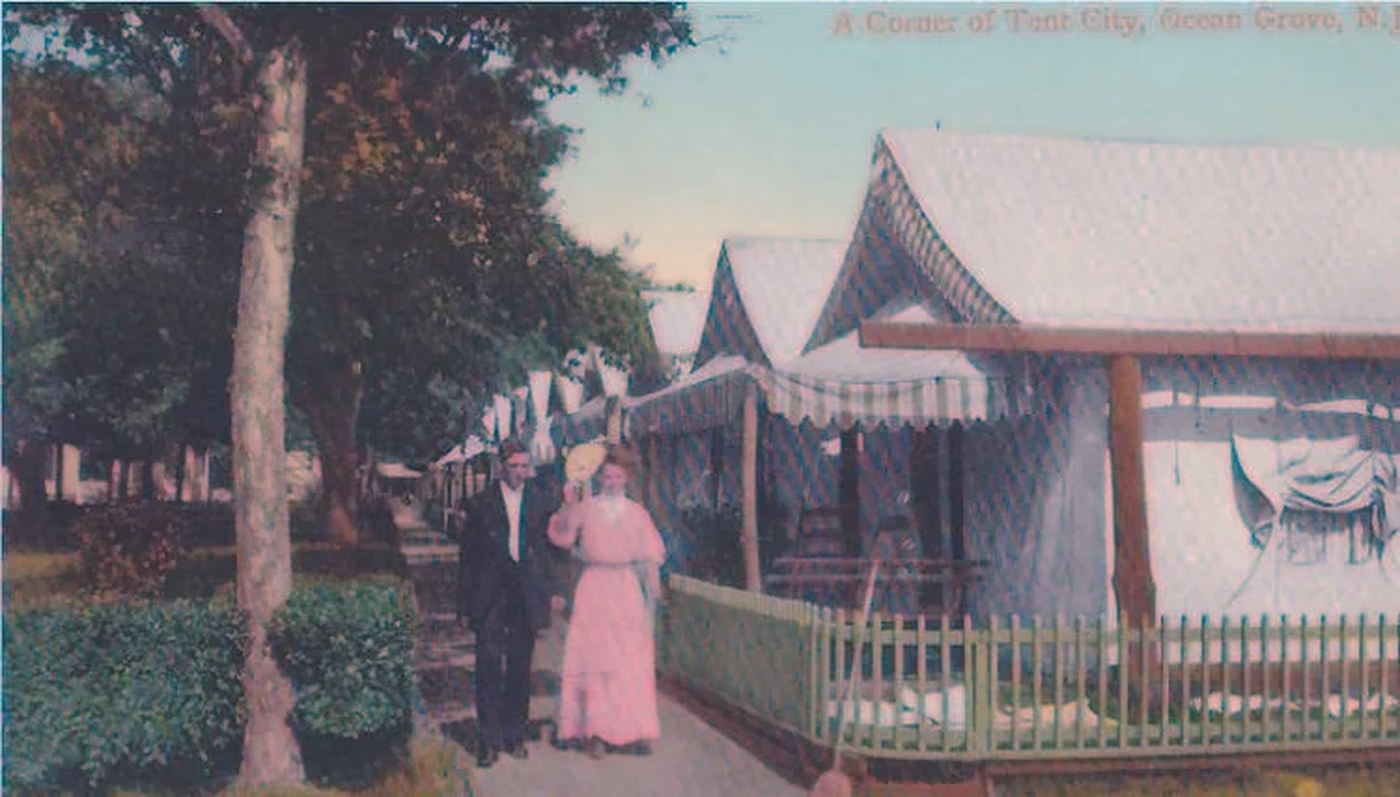
A mile square, run by a church.
Here’s the part I didn’t know, and maybe you don’t either.
In 1869, a group of Methodist ministers went looking up and down the Jersey coast for a place where, as they put it, religion and recreation should go hand in hand. They found a grove of trees between two lakes, pitched about twenty tents, and held a prayer meeting. They called it Ocean Grove. A hundred and fifty-some years later, the same association still owns the land — every homeowner holds a ninety-nine-year lease, not a deed — and the town is, to this day, dry. No bars. No liquor stores. Which is its own kind of funny, because when we wanted a drink after we wrapped, we had to drive up to Asbury to get one.
But the thing that actually stops the clock is smaller and stranger than any of that. Until 1981, you couldn’t drive a car through Ocean Grove on a Sunday. The gates are still standing at the edges of town. Add a hundred years of barely any development — the place more or less went to sleep after the First World War — and you get what’s around you now: the largest collection of authentic Victorian architecture in the country, frozen mid-century, gingerbread trim and striped awnings as far as you can see.
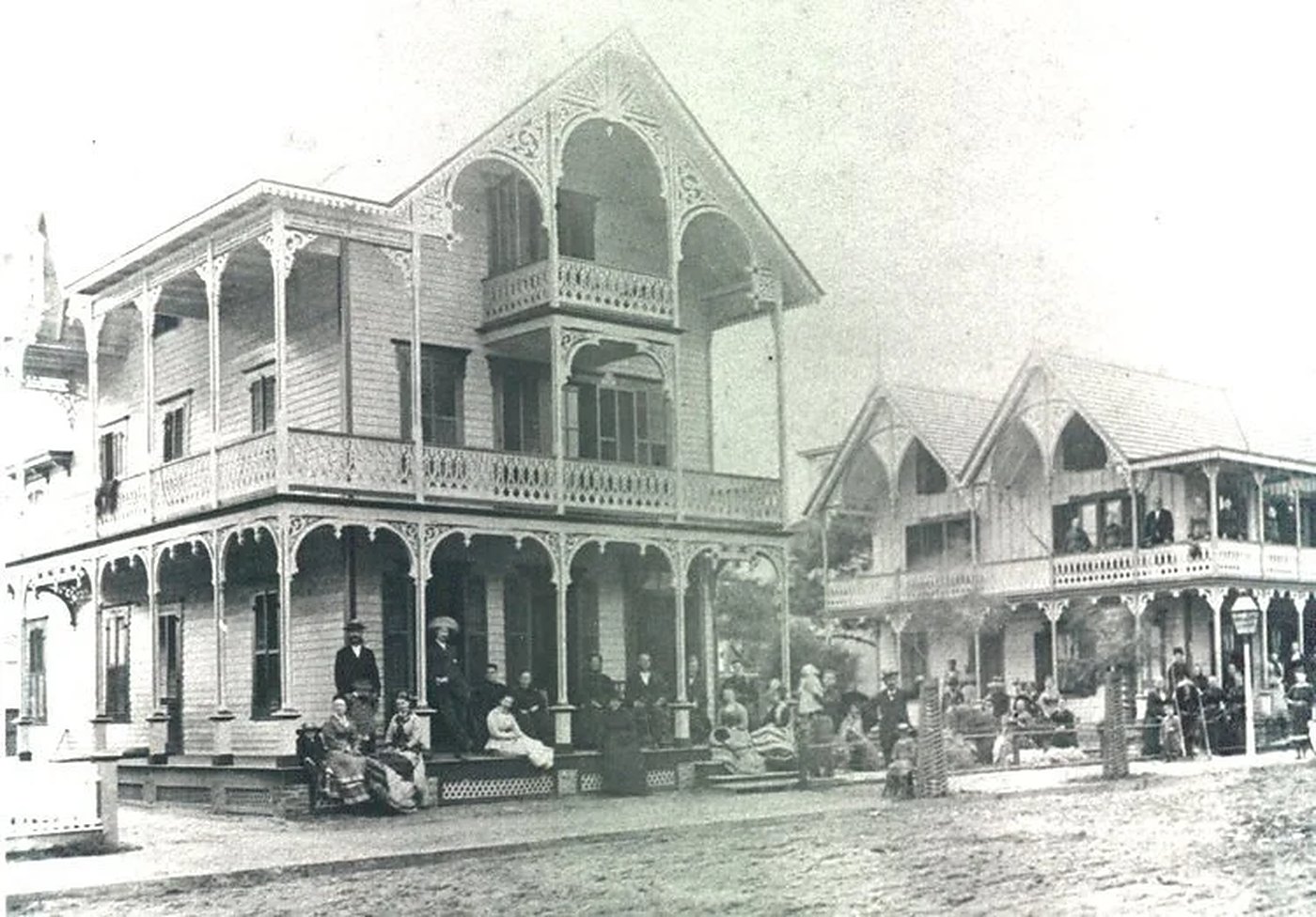
At the center of it is the Great Auditorium, a six-thousand-seat wooden barn from 1894 that Leonard Bernstein once said sounded like Carnegie Hall. Presidents have spoken there. On a Sunday the church bells play and the ushers wear blue blazers and white pants. Three blocks away, people are lying on the beach. Nobody seems to find this strange.
The tents.
Then there are the tents.
Every May, 114 canvas tents go up in tidy rows around the Auditorium, and every September they come down. They’ve done this, without missing a year, since 1869. Each one is a canvas front bolted to a little wooden cabin in back — a kitchen, a bathroom, a few beds stacked tight. Families summer in them. The same families. For generations. There’s a waiting list that runs more than ten years, and you have to interview to get in.
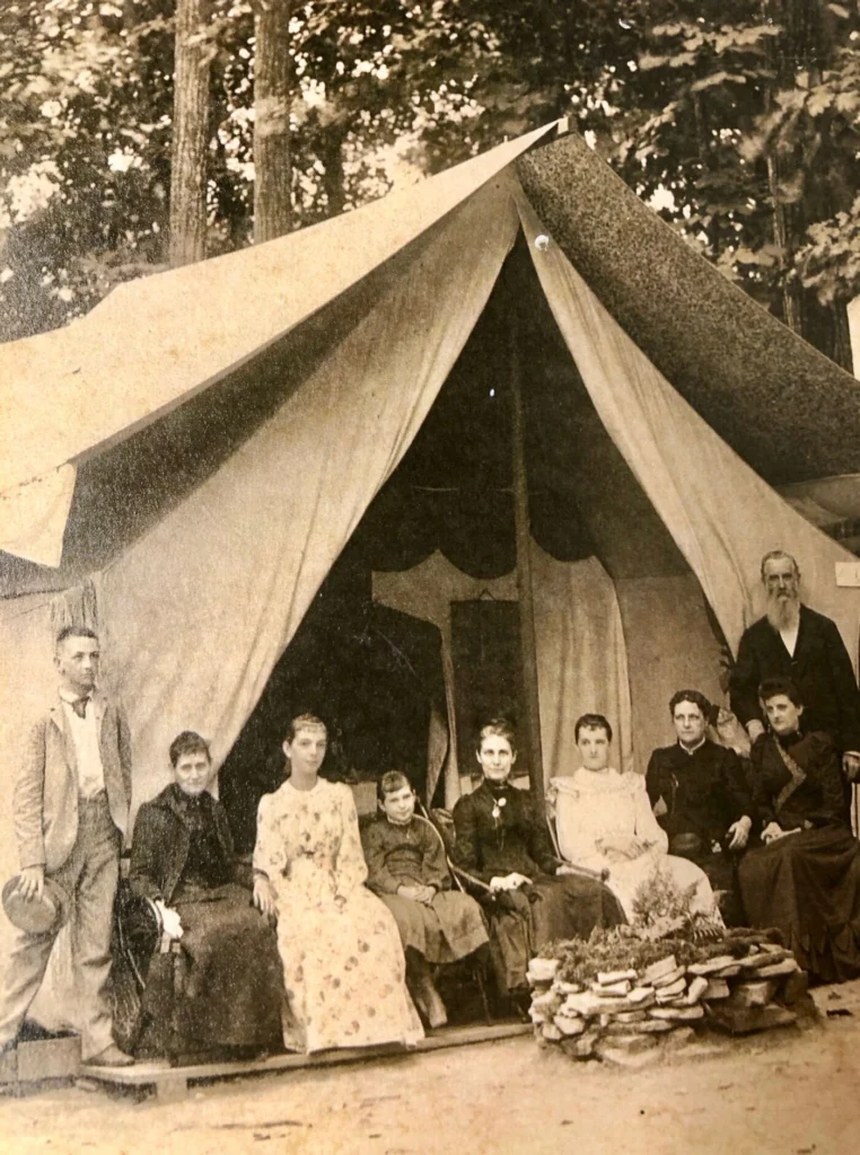
I walked one of the rows at dusk while my guide pointed out whose was whose — that one’s been her cousin’s since before she was born — and I’m telling you, it’s the single most beautiful, genuinely odd thing I’ve seen on this coast. Canvas walls. The ocean a block away. People who’ve slept to the sound of that surf every summer of their lives.
The girl who grew up on the only grass in town.
My guide, by the way, was Emily.
Emily Knight grew up here — actual childhood, actual summers — on a block called Ocean Pathway. It’s the most famous street in town and the only grass in it: a long green center aisle that runs from the Auditorium straight down to the sea. You either stare at the ocean or you stare at the church, she told me, and that’s exactly it.
Walk the town with her and the whole thing turns into a map of her own life. That’s Nagle’s, on Main, where she got her first job — waitressing the summer she was in high school. That’s the beach where she and all her friends spent their teenage summers as lifeguards; bench five, she’ll tell you, was hers, ninety percent of the time. That’s the fishing pier they used to leap off until somebody rebuilt it too far out to dare. She’s an adult with kids of her own now, and she narrates these blocks like she lived them last week.
I know this piece isn’t supposed to be about her. But here’s what I kept coming back to: when a grown adult walks you through her hometown and the love is still that palpable — still coming off her in waves, decades on — it stops being about her. That’s the town doing it. A place has to be doing something right to hold a person like that, that hard, that long.
Her parents still live in the house she grew up in, a guesthouse on the Pathway. Her dad has been in Ocean Grove for eighty years. Her mom for fifty. When I asked her mother what it was about this place, she didn’t pause:
Fifty years in, and the woman still talks about her own town like she just found it. There was a fire once that took out their whole block — jumped house to house the way these old wooden places do — and theirs came back. There’s a rack of rocking chairs and a t-shirt her mom still has somewhere that reads I Rocked in Ocean Grove, from back when every porch had one and rocking and watching the street go by was, more or less, the whole evening’s entertainment. The block even had its Hollywood moment last year: Netflix’s The Four Seasons came through and dressed up a few of these porches for the show.
Emily’s a realtor now — and full disclosure, a friend. She’d left a party in town to come shoot with me that night, which tells you something about how she works. And here’s the other thing I want you to know about her: at the end of the night I lost my wallet, and she’s the one who found it. Make of that what you will. I’d let her sell me a house.
What I drove home thinking about.
After we wrapped for the night, I took the long way back to my car — and that’s when I heard it.
There’s a place on Main Avenue called Nagle’s — an apothecary café and ice cream parlor in a building from 1890, home to the first soda fountain in all of Monmouth County. It closed in 2019, and for six years the corner sat dark. This year a restaurateur named Kelly Ryan bought it, restored it, and turned the lights back on — and one of the old traditions he brought back was the piano on the weekend. It was the same corner Emily had pointed out earlier in the night — my first job, she’d said, waitressing, in high school — back when half these houses still hadn’t been touched.
So there’s a guy named Sam Levine (@samelevine17, if you want to find him) set up on the sidewalk with a keyboard, playing Piano Man, then Hey Jude, and the thing is — people are singing. Strangers. Families on the curb, kids with ice cream, somebody’s grandparents, all of them leaning into take a sad song and make it better like they’d rehearsed it. A warm night. A dry town. No reason for any of it except that it was nice out, the music was good, and nobody wanted to go home yet.
I stood there a lot longer than I meant to.
I came to Ocean Grove for a job. I left thinking about a square mile that stopped the clock more than a century ago and never bothered to start it again — and about the twenty years I spent fifteen minutes up the road, sure I’d already seen everything the Shore had to show me.
Then a guy named Sam plays Hey Jude on a sidewalk in a town with no bars, a hundred strangers sing every word, and you understand you’d barely looked.